
CCCOWE Letter
FEB 2026
Dear CCCOWE Family,
We give thanks to God for the incredible response to the upcoming 10th CCOWE Congress, to be held this July in Kuching, Malaysia. With over 1,700 leaders from around the world registered, we reached our venue’s maximum capacity and officially closed registration this past January. We are deeply grateful for this turnout and look forward with great expectation to God’s work in and through this congress!
The composition of the participants in the Congress is both diverse and deeply representative, spanning more than 40 countries and regions. Half of the attendees are local church pastors, while the other half comprises missionaries, organization leaders, theological educators, and marketplace leaders. Most encouragingly, 15% of participants are from the younger generation under 35.
The Big Question of Our Time

Fifty years ago, the CCCOWE Declaration established that one of the movement’s core purposes is to address the most critical issues of the time. In our era, the challenges and opportunities brought by AI and technology have undoubtedly become a defining issue. I have been thinking about how fast the world is changing. With AI and digital tech everywhere, we are all facing the same big question: When algorithms know what we like better than we do, how do we keep sharing the Gospel and caring for people?
Regarding this challenge, I would like to share a few observations and reflections I have gathered recently:
1. From Programs to Presence
In an age of information explosion, people don’t come to church simply for “content.” Sermons and theological resources are available at the click of a button. Traditional “information-delivery” style preaching is increasingly failing to reach people’s hearts.
What people truly crave in a physical gathering is a genuine encounter with God and one another. Our gatherings should not be about “running through programs,” but about creating a sacred space for the Holy Spirit to move. The goal of preaching isn’t just to deliver accurate data; it is to experience God’s presence together through His Word.
2. Empowering the Digital Content Creator
While we are busy polishing Sunday liturgies and sermons, many young Christian digital content creators (YouTubers and influencers) are already sharing the Gospel on the front lines of the internet using relatable, everyday language.
Paul urged the church to “be wise in the way you act toward outsiders; make the most of every opportunity” (Colossians 4:5). Today’s young Christian creators remind us that the Great Commission belongs to every disciple. Rather than viewing them as “uncontrolled,” we should be their friends and dialogue partners! This ensures that when the Gospel is shared in the digital space, it doesn’t just have speed, but also theological depth.
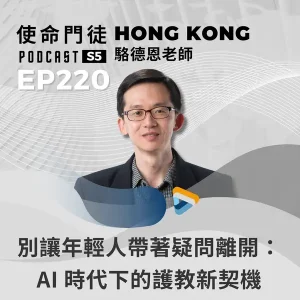
Click the image to start listening to this episode
3. Rediscover True Humanity in the Age of AI
AI is blurring the lines between technology and humanity. Today, the algorithm acts like a “shadow advisor” to the “little tyrants” we’ve become, feeding us exactly what we want to see until we lose our ability to discern reality and truth.
As the world becomes more “artificial,” the church must become more human. We must return to our theological roots to understand what it truly means to be made in the “Image of God.” We need to intentionally practice self-sacrificial love, the kind of “love” that an algorithm can never replicate or provide.
4. Who is Discipling Us?
The truth is, we are all being “discipled” by algorithms. They curate our news, polarize our tastes, and trap us in echo chambers, leading to deep divisions within the church. It has reached a point where a pastor can hardly speak from the pulpit without offending someone’s “algorithmic bias.”
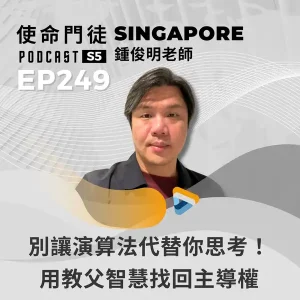
Click the image to start listening to this episode
Today we need a new kind of “algorithmic sobriety,” the courage to identify “fake gospels” and the idols we’ve been conditioned to worship. In my own life, I’ve started fighting back with three habits:
(1) First Things First: I’ve made it a rule to prioritize daily devotion and exercise before touching my phone each morning. This ensures that God’s Word enters my heart before the algorithms do. For my morning runs, I choose my podcasts the night before. This way, when I start my workout, I simply hit play on my own selection rather than letting an automated recommendation decide what I should listen to.
(2) Burst the Bubble: I’ve set up a simple AI news aggregator that pulls from a wide variety of verified, credible sources. This helps me step outside my “information bubble” and consider global and local events from multiple perspectives. It allows me to stay informed on everything from international news and church trends to critical social issues and trending online discussions, all without being limited by a single viewpoint in less than 5 minutes.
(3) Cultivating Intentional, Real-World Connections: Algorithms can mimic emotion, but they can never replace the power of true divine/human “presence.” This year, I am intentionally prioritizing prayer and devotion time with my prayer partners and colleagues. I also make it a point to schedule “quality time” every day for one-on-one interactions, ensuring that my relationships remain grounded in reality.
5. Overcoming “Anti-Intellectualism” in Chinese Churches
It is well known that there is an anti-intellectual tendency within the Chinese church. Ironically, this very tendency has become a major roadblock to discerning God’s will in the age of AI, one that we must urgently confront and overcome. In his book, Anti-Intellectualism in the Chinese Church(中國教會的反智主義), Dr. Muzhi Ge traces the roots of this anti-intellectualism and defines it as “a tendency or behavior among Christians to oppose the use of reason and dialogue when reflecting on or exploring faith and related issues.” He notes that in practice, this manifests as an anti-theological stance, a closed and dogmatic faith, and a habit of binary (black-and-white) thinking.
This anti-intellectualism in Chinese churches stems partly from our cultural heritage; Confucianism emphasizes “cultivating the self, regulating the family, governing the state, and bringing peace to the world.” Because the focus is so heavily on “self-improvement,” our theological reflection often fixates on personal sanctification rather than the nature of the Triune God. Even when we reflect on God’s work, we tend to focus excessively on Jesus Christ as the Redeemer, how he saves us, while neglecting Him as the Creator.
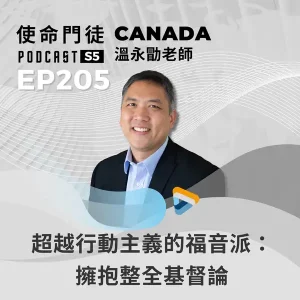
Click the image to start listening to this episode
From a historical perspective, the Chinese church of the 1920s faced the “Anti-Christian Movement.” In response, Christian intellectuals sought to demonstrate the practical value of faith in saving the nation, often leaning on liberal theology. To counter this, fundamentalist leaders of the time overcorrected. While they held onto a “utilitarian” view of faith, they emphasized Christ’s divinity so heavily that they ignored His full humanity. This has left us with an impoverished understanding of what it means to be human. Our framework for the “Image of God” remains stuck at a functional and pragmatic level, failing to draw from the rich, 2,000-year theological heritage of the Church to answer the fundamental question: “What makes us human?”
In an era of rapid AI development, this intellectual poverty is particularly dangerous. If we cannot clearly articulate the uniqueness of the Imago Dei, and instead view humans merely at a functional level, we will struggle to help our Christians stand firm in the era of the technology tsunami. We cannot live out the true meaning of the Gospel in this age if we lack deep theological roots. Therefore, confronting and breaking through this anti-intellectual tendency is no longer optional; it is an urgent challenge for the contemporary Chinese church.
Opportunities for Renewal Within the Digital Tsunami
This digital tsunami is not just a challenge; it is an opportunity for the Chinese church to transform. When “artificial” becomes cheap, the real presence of God becomes priceless.
This Lunar New Year, let’s put down our phones and truly listen to the stories of those around us. Let’s move from being passive consumers of algorithms to being active witnesses of the Gospel.
Wishing you a New Year filled with the Lord’s abundant grace!
Sincerely,

Rev. David Doong,
General Secretary of CCCOWE
February, 2026